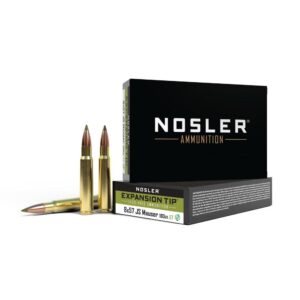
Military
8mm Mauser
Two world wars, the other side
The 8mm Mauser — properly designated 7.92x57mm Mauser — is Germany’s answer to the question of what the other side was shooting in two world wars. It is the cartridge of the Kar98k bolt-action rifle, the MG42 machine gun, the MG34, the VZ24, and practically every other German and German-influenced military arm from 1888 through 1945. It fires a .323-inch diameter spitzer bullet at serious velocity, it is accurate, powerful, and effective, and it left behind an enormous legacy of surplus rifles that collectors have been happily acquiring ever since. The winning side gets the history books. The losing side’s rifles still shoot straight.
The 7.92x57mm Mauser was adopted by Germany in 1888 for the Commission Rifle, initially with a .318-inch diameter “J” bore bullet. In 1905 it was updated to the “S” (Spitzgeschoss — pointed bullet) variant with a heavier .323-inch diameter spitzer bullet at higher velocity — the load that served Germany through both world wars and remains the standard loading today. This cartridge armed the German military in every major conflict from 1888 through 1945, fed through the iconic Gewehr 98, the shortened Kar98k, the G41 and G43 semi-automatics, and the MG34 and MG42 machine guns. It also fed many of Germany’s allies and was manufactured under license across Europe — the Czech VZ24 is one of the finest bolt-action Mauser variants ever produced and feeds it perfectly. After World War II, surplus rifles flooded the market globally and created one of the richest military collector communities in the hobby.
Military surplus collecting and shooting is where most American shooters encounter 8mm Mauser, and the collecting community around Kar98k and VZ24 rifles is substantial and passionate. The cartridge is fully capable for deer and larger game hunting — it delivers performance comparable to .30-06 Springfield and was used extensively for hunting in Europe for decades. Competitive military surplus shooting with Mauser-pattern rifles has a dedicated following. Some long-range target shooters use European sporting rifles chambered in 8mm Mauser. The sheer volume of Mauser-pattern rifles produced means there are millions of platforms for this caliber in private hands worldwide, and the collector market rewards condition, provenance, and matching numbers.
Modern factory loads for 8mm Mauser are often downloaded from the cartridge’s actual potential to account for the large number of older surplus rifles that may be in less-than-perfect condition. Typical commercial loads push a 196-grain bullet at around 2,550 feet per second, generating approximately 2,830 foot-pounds of muzzle energy. In strong modern actions with fresh barrels, the 8mm Mauser is capable of .30-06 class performance with handloads using quality 175 to 200-grain projectiles. The .323-inch bullet diameter is not shared widely with other American calibers, so bullet selection for handloading is more limited than with .308-inch bore cartridges, but European manufacturers offer excellent options. Military surplus FMJ ammunition, while corrosive in most cases, remains available and has kept the caliber accessible for high-volume shooters.
Factory ammunition from PPU, Sellier and Bellot, and occasionally Hornady and Federal keeps the caliber commercially viable. Military surplus corrosive FMJ is still available through channels that serve the surplus market, and while corrosive ammo requires attentive cleaning protocols, it shoots fine and is often significantly less expensive. Hunting loads with soft-point bullets are available from European manufacturers. Handloaders have access to .323-inch bullets from Hornady, Sierra, and various European makers. Handloading 8mm Mauser is worthwhile for anyone who shoots it seriously — it unlocks the cartridge’s full potential in modern actions and allows use of quality hunting projectiles that the downloaded factory loads don’t provide.
The Kar98k is the king of the 8mm Mauser platform world — the definitive WWII German service rifle and one of the most collected military surplus firearms in the hobby. Matching-numbers examples in original condition command serious collector premiums. Shooter-grade examples are more accessible. The Czech VZ24 is considered by many to be mechanically superior — tighter tolerances, excellent fit and finish, and well-regarded by accuracy-focused shooters. The Yugoslav M48 is the most common budget-friendly Mauser variant. Swedish Mausers are chambered in 6.5×55 rather than 8mm, which is a common source of confusion for new collectors — check before you buy. Various pre-war and wartime commercial Mauser sporters exist in European collections and the American market. The Mauser 98 action is also the basis for nearly every quality bolt-action sporting rifle manufactured in the 20th century, which is itself a testament to how well it was designed.
The military surplus collector community is our kind of people, and 8mm Mauser enthusiasts are welcome here. We carry 8mm Mauser ammunition and Mauser-pattern rifles cycle through our inventory regularly — Kar98k, VZ24, M48, and others when we have them. If you’re building a collection, looking for ammunition for a rifle you already own, or just starting to explore the world of WWII German and European military surplus, come in. We know these rifles, we know the history, and we’ll treat your questions with the seriousness they deserve. The collector community around this cartridge is one of the best in the hobby. We’re glad to be part of it.